
Why Choose EduExpert
We are deeply familiar with the Erasmus+ programme, and we support schools throughout the entire process—from preparation and documentation to on-site assistance and post-course follow-up. Our goal is to make participation smooth, enjoyable and professionally rewarding for both teachers and coordinators.
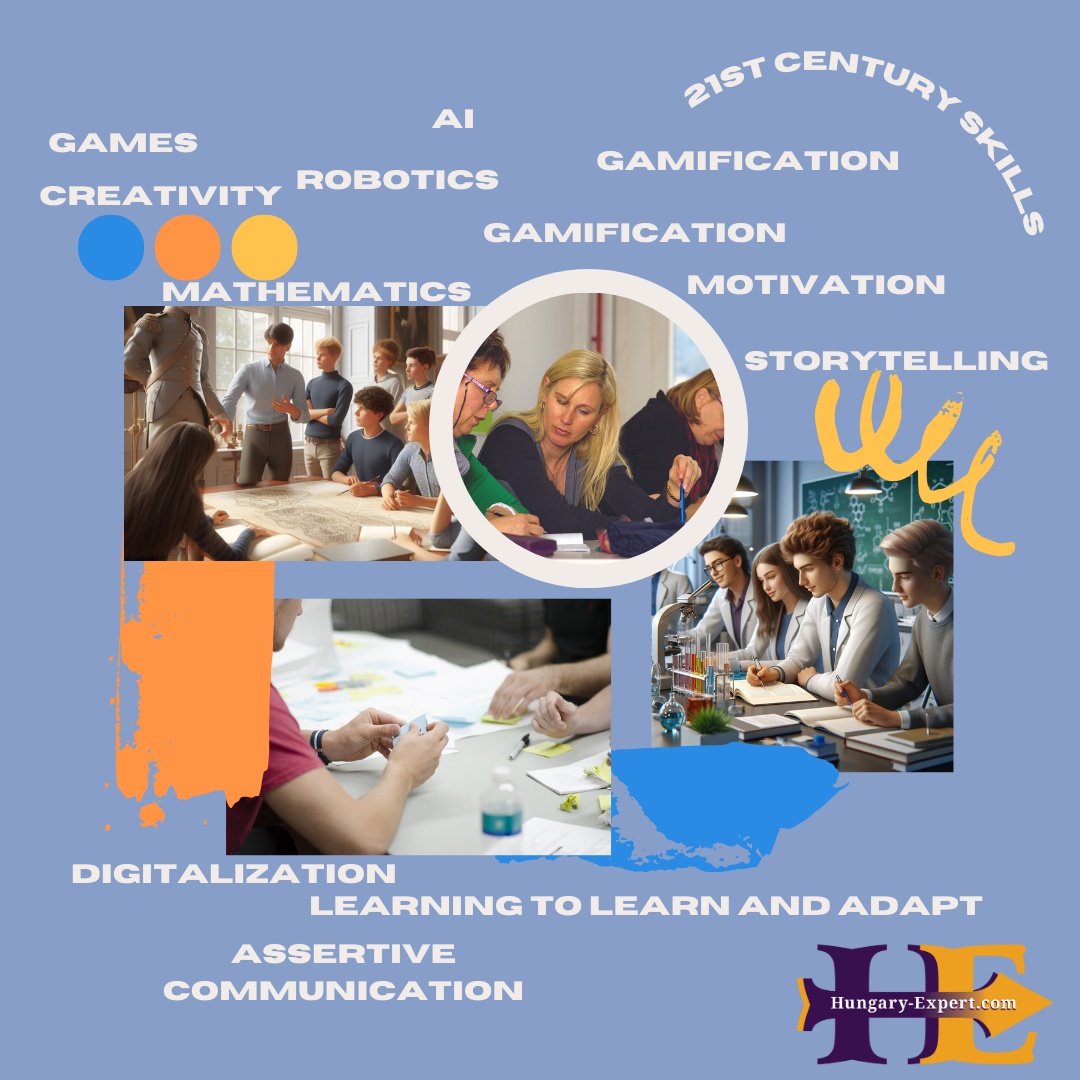
21st Century Skills: Learning to Learn, Reflect and Adapt CONFIRMED
- Zoltán Rézműves
- 35 lessons, 7 days
- English - B2
- 12 July 2026
-
21st-century learning shifts the emphasis from acquiring specific lexical knowledge to developing a more flexible ability to learn and to adapt in new situations.
-
Learning is not limited to the language classroom but also continues throughout life (lifelong learning).
Description
The central idea of 21st-century learning skills is that in today’s fast-changing world what students need is less about memorising particular pieces of knowledge (what they learn) and more about developing skills that help to acquire any new skill and to adapt flexibly to any new situation (how they learn). The core competencies identified as 21st-century learning skills are cooperation, critical thinking, communication, creativity, and culture. Also essential to the notion of 21st-century learning is that it is no longer restricted to institutional education, but that it continues throughout life. This course aims to highlight how applying the principles of 21st-century learning affects our teaching in the language classroom. Participants will explore techniques and strategies they can employ in supporting learners in developing flexibility and general learning skills. The course also offers a chance to participants to share ideas and experiences with colleagues through regular swap shop sessions aimed at exchanging tips and activity suggestions. By the end of the course, participants will have a clearer understanding of what 21st-century learning skills are, and how they are relevant to the language classroom as well as familiarise themselves with techniques to develop their own learners’ 21st-century competencies.
Aims and Objectives
-
You will familiarise yourself with approaches and techniques to develop your learners’ 21st-century learning skills: cooperation, critical thinking, communication, creativity and culture.
-
You will have a chance to share and exchange ideas with your colleagues – an approach that can be applied and extended to your language classes.
Learning Outcomes
Participants to the course will learn to:
- identify 21st-century learning skills and apply these to their teaching contexts;
- use strategies and techniques to build and maintain motivation and cooperative classroom dynamics;
- employ a wider range of approaches to group work and pairwork;
- understand the role of cross-curricular learning in the language learning process;
- promote their learners’ creativity and critical thinking;
- work more effectively with cultural and art content in English classes;
- reflect on the importance of supporting lifelong learning.
Audience
- Target group:
- Language teachers: upper primary level; secondary level, adults, vocational
Please click here to register if you wish to participate in this course.
Short Description
Class Times
| Sunday | Monday | Tuesday | Wednesday | Thursday | Friday | Saturday |
|---|---|---|---|---|---|---|
|
Arrival, introduction of the course and the location, introduction of the participants
Registration during the day
14.30 – 15.00: Familiarisation with the site, health and safety briefing
15.00 – 17.30: Introduction of the course and trainer, introduction of the participants – 5 minutes for each participant to introduce themselves and their institution and the objectives they wish to achieve by completing the course
18.00 – 19.30: Informal get-together with the course participants over dinner.
|
21st century learning skills, and their relevance to teaching practices
The 5Cs: cooperation, critical thinking, communication, creativity, culture
The role of 21st century skills in the participants’ schools: discussion
|
Establishing and maintaining learner motivation
Classroom dynamics: building a supportive learning environment
Motivation swap shop: exchanging participants’ ideas
|
Cooperative learning: optimising groupwork and pairwork
Inquiry-based learning / Cross-curricular learning
Pairwork and groupwork swap shop: exchanging participants’ ideas
|
Developing creativity: generating ideas and providing flexible support
Project work: combining creativity with language skills
Projects swap shop: exchanging participants’ ideas
|
Presenting and working with cultural content in the classroom
Review: 21t century skills in lifelong learning
Networking – Games without borders! (compulsory programme)
|
End of the course – cultural programme
8.30 – 10.00: What did I learn this week? Preparing for dissemination – 5 minute presentation from each participant
10.00-10.15- Break
10.15-11.00: Evaluation and feedback of the course
Certificates, attendance certificates
Certificate issue – photography
11.30-16.00: Cultural programme – boat trip
|